
Closeup of a Ford steering wheel

Nearshoring Is Costing More Than Companies Expected

Ford announced in 2023 that it would delay a $12 billion investment in new EV battery plants in Michigan. The decision wasn’t about demand or feasibility. It was about labor costs. Building battery production in the Midwest costs roughly 40% more than building it in Mexico or Asia. That gap is forcing every major automotive manufacturer to make uncomfortable choices about where to actually locate new capacity.

The U.S. government has poured billions into the Inflation Reduction Act, specifically designed to incentivize domestic battery and EV manufacturing. The intent was clear: build American, stay competitive, secure the supply chain. The reality is messier. Companies are building in America, but they’re doing it reluctantly, in smaller increments than planned, and while searching for every possible cost reduction.

The Wage Problem Nobody Wanted to Admit

Skilled automotive manufacturing workers in the American South and Midwest earn roughly $25-35 per hour with benefits. In Mexico, comparable workers earn $5-8 per hour. In Vietnam and Indonesia, it’s even lower. These aren’t small differences. Over the lifecycle of a 20-year manufacturing facility, wage costs compound into billions of dollars in difference.

The U.S. government’s incentive structure doesn’t erase this gap. A $7,500 EV tax credit, or even a $5 billion federal grant to a manufacturer, doesn’t overcome a 400% wage differential. It makes American production defensible. It doesn’t make it obviously profitable.

Stellantis, which manufactures in both the U.S. and Mexico, has been caught between these economics for years. The company built a battery plant in Windsor, Ontario (higher wages than Mexico, lower than the U.S. Midwest) and continues expanding Mexican production capacity. That’s not because Stellantis prefers Mexico. It’s because the company has shareholders demanding returns, and wage economics are real.

Where Nearshoring Actually Works

The reshoring movement has succeeded in a few specific areas. Advanced manufacturing, automation, and high-margin products benefit from U.S. production. High-tech battery chemistry research and development remains concentrated in the U.S., Europe, and Asia because the talent pool and capital density matters more than hourly wages.

Intel’s decision to build chip fabrication plants in Arizona and Ohio made sense because semiconductor manufacturing requires proximity to customers, supply chain partners, and specialized talent. The company faced supply chain vulnerabilities after COVID. Building domestically addressed that. But Intel also moved some lower-margin production overseas and kept the most advanced chip fabrication in California.

Applied Materials, which manufactures semiconductor equipment, saw surging demand from both U.S. and international customers. The company expanded U.S. production capacity, not because wages became competitive with Asia, but because U.S. demand spike made serving customers from domestic plants more efficient. Once demand normalized, some of that expansion didn’t pencil out as planned.

The lesson is specific: nearshoring works when supply chain resilience matters more than cost per unit. It works when customers demand it and are willing to pay for it. It doesn’t work when the product is price-sensitive and the wage gap is structural.

The Geography Trap

Texas, Tennessee, and Kentucky have invested heavily in attracting manufacturing. These states offer tax incentives, lower energy costs than the Midwest, and relatively lower (though still higher than Mexico) labor costs. They’re becoming the compromise location for manufacturers who need American production but can’t absorb Midwest wage structures.

Lucid Motors built its manufacturing facility in Arizona. Tesla chose Texas for its newest factory. Ford and GM have both expanded in Tennessee. These aren’t random choices. Arizona and Texas offer lower electricity costs, lower labor costs than Michigan, and proximity to growing Southwest markets. They’re not cheap by global standards. They’re just cheaper than the traditional automotive manufacturing heartland.

The problem this creates is real. Manufacturing jobs are still moving, but they’re moving from Michigan and Ohio to Texas and Tennessee. Workers in legacy auto communities are watching production shift south. It’s cheaper than Mexico for the company. It’s still often cheaper than their own communities. The regional wage premium that made the Midwest the automotive center for 100 years is being arbitraged away.

What This Means for Supply Chain Resilience

The original argument for nearshoring was supply chain security. Getting battery and semiconductor production closer to end-use markets reduces vulnerability to global disruptions. That still matters. But it’s being balanced against cost pressure in ways that limit how much reshoring actually happens.

A manufacturer could build a fully domestic supply chain. The cost premium would be 20-30% above a globally optimized supply chain. That’s not sustainable for price-sensitive products like batteries or commodity semiconductors. So companies are building a hybrid approach: critical components and advanced products built domestically, commodity components built offshore, and final assembly near customers.

This is pragmatic. It’s not what policymakers hoped for when they passed the Inflation Reduction Act. They wanted American manufacturing expansion. What they got was managed localization. Companies are making domestically strategic production decisions, not building new American manufacturing heartlands.

The Worker Story Nobody Talks About

A worker in a shuttered transmission plant in Michigan can retrain and move to a battery plant in Tennessee. The job is better than unemployment. The wage might be similar, or slightly lower. The cost of living in Tennessee is lower, so the real purchasing power might improve. But it requires leaving community, family, and social networks. For many workers in their 50s, that’s not a realistic option.

A worker in Monterrey, Mexico earning $7 per hour sees an opportunity at $12 per hour in a new facility. That’s a 70% wage increase. A worker in Michigan earning $30 per hour sees the same job available to someone in Mexico for $7. That’s a threat, not an opportunity.

The nearshoring strategy avoids this by building new capacity in lower-cost U.S. regions rather than expanding legacy production centers. But it doesn’t solve it. It relocates the problem. And it means that the economic gains from manufacturing jobs aren’t distributed evenly across the country.

The Reality Check

Nearshoring is real. It’s happening. But it’s not creating a manufacturing resurgence. It’s creating selective reshoring in specific sectors where supply chain resilience justifies higher costs. Outside those sectors, offshoring continues. Companies are optimizing globally, not building redundancy for resilience’s sake.

Policymakers wanted American manufacturing. What they got is American manufacturing where it makes economic sense, supplemented with tax incentives to make it make sense in a few more places. The jobs are real. The investment is real. But the scale is smaller and the wage pressure is stronger than anyone publicly admitted when these policies were being designed.

For manufacturers, this means continued pressure to find cost advantages within the American production footprint. For workers, it means jobs are available, but they might not be in your community. For policymakers, it means that supporting nearshoring requires accepting that it won’t restore the manufacturing economy to what it was. The economics have changed. Policy incentives can influence where production happens, but they can’t reverse the structural wage advantages of global production.


Sources

Duhalt, Adrian. “How the US-China Trade War and the Inflation Reduction Act Could Shape Mexico’s Nearshoring Future.” Baker Institute, 23 Apr 2024, https://www.bakerinstitute.org/research/how-us-china-trade-war-and-inflation-reduction-act-could-shape-mexicos-nearshoring-future.

Silva Eguibar, Oscar. “Nearshoring in Mexico.” Roland Berger, 2024, https://www.rolandberger.com/publications/publication_pdf/Nearshoring-in-Mexico_Roland-Berger-Report-2024.pdf.

Lellouche Tordjman, Karen, et al. “The Shifting Dynamics of Nearshoring in Mexico.” Boston Consulting Group, 16 Aug 2024, https://www.bcg.com/publications/2024/shifting-dynamics-of-nearshoring-in-mexico.

“Mexican wave of nearshoring firms is all at sea.” Reuters Breakingviews, 19 Mar 2024, https://www.reuters.com/breakingviews/mexican-wave-nearshoring-firms-is-all-sea-2024-03-19/.

Alvarez & Marsal. “De-Risking Global Supply Chains: Part 2 – Nearshoring to Mexico – Operating Cost vs. the US.” October 2024, https://www.alvarezandmarsal.com/sites/default/files/2024-10/Part%202-%20Nearshoring%20to%20Mexico%20-%20Operating%20Cost%20vs.%20the%20US.pdf.
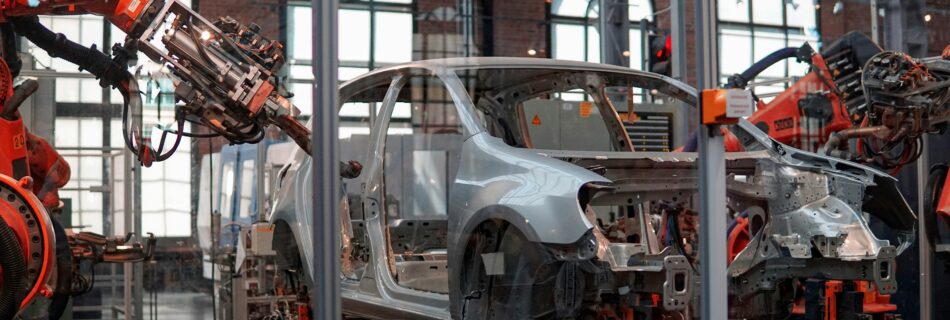
a car manufacturing plant

Why Manufacturing’s EV Transition Is So Painful Right Now

Battery manufacturing capacity in North America has expanded from roughly 30 gigawatt-hours in 2020 to over 150 GWh today. Five years ago, that would have been cause for celebration. Today, it creates a different kind of problem entirely.

The automotive supply base is bleeding. Profit margins among suppliers have fallen from 8.5% in 2017 to roughly 3% today. Companies are locked in this brutal position: legacy diesel and gasoline production still generates cash, but the transition to electric demands billions in upfront capital with no guarantee of profit. The question isn’t whether the industry will electrify. It’s whether the suppliers, manufacturers, and workers in the middle of this transition can survive it.

The Capacity Paradox

The U.S. now has over 15 active battery manufacturing facilities, with another 10+ under construction or planned. Ford, GM, Stellantis, Hyundai, LG, SK Innovation, and Ultium Cells have all committed billions to North American production. By 2030, domestic capacity is projected to exceed 400 GWh annually, enough to supply roughly 4 million EVs per year. These numbers should inspire confidence.

Instead, most of these plants are running below 50% utilization. EV sales in the U.S. hit 1.6 million units in 2024, up from 1.2 million in 2023, which is solid growth. It’s just not enough to absorb the production capacity being built. When you’ve borrowed billions to construct a facility, 50% utilization isn’t a business plan. It’s a problem you’re counting on demand to solve.

There’s another constraint nobody talks about enough: lithium. The U.S. produces roughly 0.1% of the world’s lithium. While the government has pushed hard on nearshoring, bringing production closer to home rather than relying on Australia, Chile, and China, the domestic mining infrastructure doesn’t exist yet. Most operations are still in development or stuck in permitting delays. Cobalt, nickel, and other critical minerals face the same bottleneck. Until U.S. mining scales up, the industry stays dependent on imports, which keeps supply chains fragile and costs high.

The Supplier Squeeze

Traditional suppliers built their entire business on producing engines, transmissions, and fuel systems. Those components will keep generating revenue for another 15+ years. Diesel trucks aren’t disappearing. The problem is that this revenue is in managed decline while EV production requires completely different expertise: battery pack integration, power electronics, thermal management. A company that made billions on fuel injector systems can’t just retool and start competing in battery electronics.

The transition demands R&D investment, workforce retraining, and massive capital expenditure at a time when cash flow is tightening. Some of the largest suppliers have committed $5-15 billion each to pivot their operations. For hundreds of smaller regional suppliers, that level of investment is simply impossible.

The result is consolidation. Tier-1 suppliers are acquiring competitors, regional shops are shutting down, and workers are facing retraining or layoffs. This happened before, during the shift from carburetors to fuel injection, but it took longer. Today’s timeline is compressed. The window to adapt has shrunk from decades to years.

Where the Money Is Actually Going

There are real investments happening that move past the grim narrative. Capital is flowing toward three areas that will shape the next decade.

Battery chemistry. CATL, BYD, and SK Innovation have all published research on solid-state battery architectures. These promise higher energy density and lower costs than lithium-ion. The U.S. lags here. Most advances are coming from Asia. But American companies like QuantumScape and Solid Power are developing domestically produced solid-state cells, with commercial viability expected around 2027-2028. This matters because solid-state could cut battery costs and improve performance faster than incremental lithium-ion improvements.

Manufacturing automation. Battery pack assembly is still incredibly labor-intensive. A single pack takes hours to assemble manually, with workers hand-soldering connections and stacking cells. Tesla, Redwood Materials, and emerging startups are building fully automated lines where robots handle most of the work. Tesla’s Berlin factory has shown how this reduces labor per unit compared to traditional plants. The yield rates aren’t perfect yet, but they’re improving. This matters because automation makes battery manufacturing competitive in high-wage countries.

Recycling operations. Redwood Materials and Li-Cycle are building battery recycling systems that recover lithium, cobalt, and nickel from used packs. If you recover 95% of lithium from an end-of-life pack, you’ve reduced your mining dependency by that amount. By 2030, recycled materials could supply 10-15% of U.S. lithium demand. It won’t eliminate the mining shortage, but it’s real supply that doesn’t require new mines or the environmental costs that come with them.

The Skills Gap

Advanced battery manufacturing requires skills that weren’t common in traditional automotive production. Cell chemistry, power electronics, thermal systems. A worker who’s spent 20 years on a traditional production line doesn’t automatically bring those capabilities to a battery pack facility.

Ford, GM, and Stellantis have partnered with community colleges and vocational schools to build training programs. Community colleges in Michigan, Ohio, and Indiana have trained thousands of workers. The pipeline is working, though demand still outpaces supply.

Here’s what training programs can’t fix: geography. Some workers will retire rather than retrain. Others live nowhere near new battery plants or EV component facilities. The old manufacturing corridors aren’t where the new jobs are. A worker in a shuttered transmission plant in Ohio can’t just move to a new battery facility in a different state. The geographic mismatch creates real hardship that retraining alone won’t solve. It’s a cost that sits beneath the statistics.

What This Looks Like on the Ground

For a traditional supplier, sitting still is no longer an option. Companies waiting to see if EVs really take off are losing market share and strategic position. Bosch committed $8 billion to electrification. ZF is restructuring around power electronics and software. The ones making real investments now will own the market in 2035. The ones hoping legacy production carries them another decade are quietly fading.

For manufacturers, the math is brutal. Legacy operations generate most of the profit but are in managed decline. EV production is growing but unprofitable. There’s no perfect way to balance this. GM’s decision to separate EV operations from legacy production is one answer. Tesla’s relentless focus on manufacturing automation is another. Each company is finding its own path through this, but inaction is the only strategy that guarantees failure.

For workers, the direction is clear. Advanced battery manufacturing will grow. So will power electronics, thermal management, automation. These aren’t trendy buzzwords. They’re where jobs are being created and where they’ll stay created. Workers developing these skills will find opportunities. Those who don’t will find the job market narrowing.

The Transition Won’t Be Quick

The automotive industry is electrifying. Capacity is being built. Capital is flowing. This is real. But the path there is expensive, painful, and slower than anyone predicted. Suppliers with half-empty plants aren’t going out of business next year. They’re just slowly losing value. Workers in legacy production aren’t immediately unemployed. They’re just aware that their skills have an expiration date. This is an industry-wide adjustment that will take longer to complete than it already has.

The companies surviving this period are the ones making choices instead of hoping for the best. They’re investing in automation even when labor costs don’t yet justify it. They’re building mining and recycling infrastructure knowing they won’t be profitable for years. They’re shutting down facilities in expensive regions and opening them in cheaper ones, displacing thousands in the process.

The question isn’t whether the industry transitions. That’s happening. The question is whether you’re part of the solution or the problem. For suppliers and manufacturers, this means choosing what bets to make with limited capital. For workers, it means developing skills that will matter in five years, not maintaining expertise that matters today.

The manufacturing transition to electric is real. It’s just taking longer and costing more than it should.

Works Cited

U.S. Department of Energy. “Biden-Harris Administration Announces 14 New Investments Supporting Domestic Battery Manufacturing.” Energy.gov, https://www.energy.gov/articles/biden-harris-administration-announces-14-new-investments-supporting-domestic-battery-manufacturing.

U.S. Geological Survey. “Where Do We Get Lithium?” USGS, https://www.usgs.gov/faqs/where-do-we-get-lithium.

PR Newswire. “Bosch Plans to Invest Over 8 Billion in Electrification.” PR Newswire, https://www.prnewswire.com/news-releases/bosch-plans-to-invest-over-8-billion-in-electrification-301765098.html.

Tesla. “Berlin Factory.” Tesla, https://www.tesla.com/berlin-factory.

U.S. EV Sales Data. 1.6 million units (2024), 1.2 million units (2023). Industry reports and EV trade publications.

Manufacturing Supplier Profitability. Margins declining from 8.5% (2017) to approximately 3% (current). Data sourced from MEMA (Motor Equipment Manufacturers Association) analysis and automotive supply chain research.